
How Culture Promotes Innovation… Or Doesn’t
Albert Camus said “Without culture, and the relative freedom it implies, society, even when perfect, is but a jungle. This is why any authentic creation is a gift to the future.” Many organisations are content to be a jungle. Others will look to create a culture by design. This article will speak to the latter.
The key takeaway being that you don’t automatically inherit an organisational culture that promotes innovation; you have to create it intentionally. One of the most underappreciated elements of organisational culture is psychological safety. You surely know if you don’t have it, but you likely undervalue it if you do.
The link between psychological safety and innovation
Amy Edmondson, Harvard Business School professor, coined the term "team psychological safety" in her landmark 1999 paper in Administrative Science Quarterly (now cited over 19,000 times). She defined it as “A shared belief held by members of a team that the team is safe for interpersonal risk taking.". Her key finding was that safety doesn't directly improve outcomes. It enables the learning behaviours (asking questions, experimenting, admitting mistakes, giving honest feedback) that produce better outcomes.
It isn’t explicitly mentioned above, but if we are being reductive, this is all about trust within groups. We trust each other to safely take risks, which may be interrogated for betterment, but not derided for political or personal gain. Interestingly, Google’s Project Aristotle spent two years studying 180 internal teams, running 35+ statistical models, to find what makes teams effective. Psychological safety ranked as the #1 factor (of five) in team effectiveness — ahead of dependability, structure, meaning, and impact.
Here are some of the key outcomes for teams with high psychological safety-
Rated effective 2x as often by executives
17% higher sales target achievement (vs. low-safety teams falling 19% short)
31% more innovation
27% lower turnover
Reinforcing Google’s findings are a meta-analysis from 2017 by Frazier et al., which looked 136 studies covering 17,000 individuals showing that-
Psychological safety has a strong correlation with learning behaviours (ρ̂ = .62) — the strongest effect of any outcome measured
Strong correlation with task performance (ρ̂ = .43), information sharing (ρ̂ = .52), and work engagement (ρ̂ = .45)
Effects are strongest in knowledge-intensive settings — precisely where innovation matters most (Sanner & Bunderson, 2015)
The relationship holds across 39 countries and multiple industries (Edmondson & Bransby, 2023 review of 185 papers)
We can infer from the above, that higher psychological safety produces far improved outcomes, especially for innovation and that it is critical for culture. It is especially important in knowledge-intensive settings such as our for purpose sector. So let’s unpack how you might go about intentionally crafting more psychological safety into your culture to promote innovation.
Promoting psychological safety by reducing risk
First off, it’s important to say that psychological safety can be radically different across teams and that it’s highly subjective. One way I think about it is, if I run a workshop in a client organisation that has a mix of people from across the organisation and from all layers of hierarchy, how willing are participants to speak up and share original and potentially unpopular ideas. The same applies to how organisation’s operate day-to-day in all manner of meetings and informal communications.
How do leaders react to new and at times challenging ideas that may not align with the current status quo or thinking? These reactions can promote or degrade safety and innovation in a pinch. The goal is to move toward a higher psychological safety setting and what Edmondson refers to as the “Learning Zone”, where people feel safe AND are held to high standards; this is where innovation happens.
To get there there is a need to overcome some key fears, called the Four Fears that block innovation. When people assess whether to speak up, propose an idea, or try something new, they unconsciously weigh four interpersonal risks:
Fear of looking ignorant — "If I ask this question, people will think I don't know what I'm doing"
Fear of looking incompetent — "If this experiment fails, it'll reflect badly on me"
Fear of looking negative — "If I criticise this program, people will think I'm not committed to the mission"
Fear of being seen as disruptive — "If I challenge the way we've always done things, I'll be seen as a troublemaker"
The work here has to be around reducing these fears as close to zero as possible. I like to look at how people communicate in meetings where there are people from various layers of seniority present. Is most of the talking left to those with perceived power and executive trust, or is there distributed contribution across the group. How careful are people who hold an idea they might consider controversial or contrary to the status quo. Do they speak up; or not at all? Is there a fear of not being mission or culturally-aligned for being constructively critical?
When I ran our first Shark Tank at Good Shepherd, I was a bit embarrassed as out of our 450 staff, I was only able to get less than a handful of submissions that would have won those people and their teams internal innovation funding of $50,000. I talked to my team and people who I thought might not have submitted ideas but had them and felt that we needed to do more work on explaining what good ideation and problem-solving looks like in practicte, before getting a pipeline of great ideas submitted.
In the week following the workshop we ran, we went from less than 10 innovation ideas to 40. We eventually finished our Shark Tank in 2024 with 10% of people in the organisation submitting an idea, and overall 40% of staff actively involved in contributing to those ideas in a group setting before they came in for assessment. What was the key driving factor here? The ideation workshop or the signal that the workshop made, that we as leaders are here to help you be part of this and will support you on the journey. I think it was the signal of intent and a feeling we effectively conveyed that the senior leaders and culture supported these innovation behaviours.
What psychological safety means for innovation readiness
Innovation is a high-stakes proposition and leading it or delivering it is both stressful and precarious because over 80% of your efforts will fail. The good news is that 20% will succeed and produce high growth and impact products, processes or services that will make your portfolio good. It’s no coincidence that this mirrors the Pareto or 80/20 rule, that 20% of our efforts produce 80% of the outcomes. So, innovators need your support and the support of their whole organisation and it’s culture because they take on a lot of stress and risk. This is especially so in a society where
Only 6% of executives are satisfied with their innovation performance
85% of innovation practitioners say fear holds back innovation in their organisations "often" or "always."
Only 28% of Australian workers feel safe to take a risk at work
46% of employees withhold honest feedback at work
You can reduce this risk and promote better organisation-wide innovation practices by:
Create spaces for experimentation: At Infoxchange, we implemented a protected end of week ritual that meant on Friday’s team members had a protected half day off per week (10%) to work on improving how they worked or how the team could work better. This was a blank canvas approach, but we set the expectation that at each weekly meeting we’d all share what we were working on, how it was going and if it improved productivity or outcomes. This generated some great results in both process innovation and better use of existing technologies to support our team charter. It also improved team and individual morale and engagement.
Shifting to positive language: A simple shift from naming failure, to a ‘mid-course correction’ or a ‘pivot’ is far better language that is more motivational and more synonyomus with startup culture and norms. This removes blaming from the conversation, which I’ve found is a clear and dangerous signal of poor leadership and culture. You can also share an understanding that innovation projects by their very nature are experimental and don’t involve the same linear trajectory as many not for profit projects. There are milestones, but measures of success aren’t as binary. A key measure of success for any innovation project or experiment is the ongoing learning, regular reviews and post implementation review. You never fail if you learn something new that can help you be better in future.
Encourage more diverse groups: Bring together groups of people from a wide range of role seniority, gender, age, experience and ethnicity to workshop problems. Intentionally designing groups this way introduces a wide range of perspectives, often unexpected that can not only de-risk your innovation process, but make it far more interesting, fun and engaging. Running innovation hours at Good Shepherd, where we would bring in a leading female innovator from another sector would invite new perspectives but also open up a space to discuss these new perspectives within our existing organisational context. I would also directly invite people from a range of backgrounds, disciplines and teams to try and get the best mix possible to enable generative group discussion and diverse perspectives.
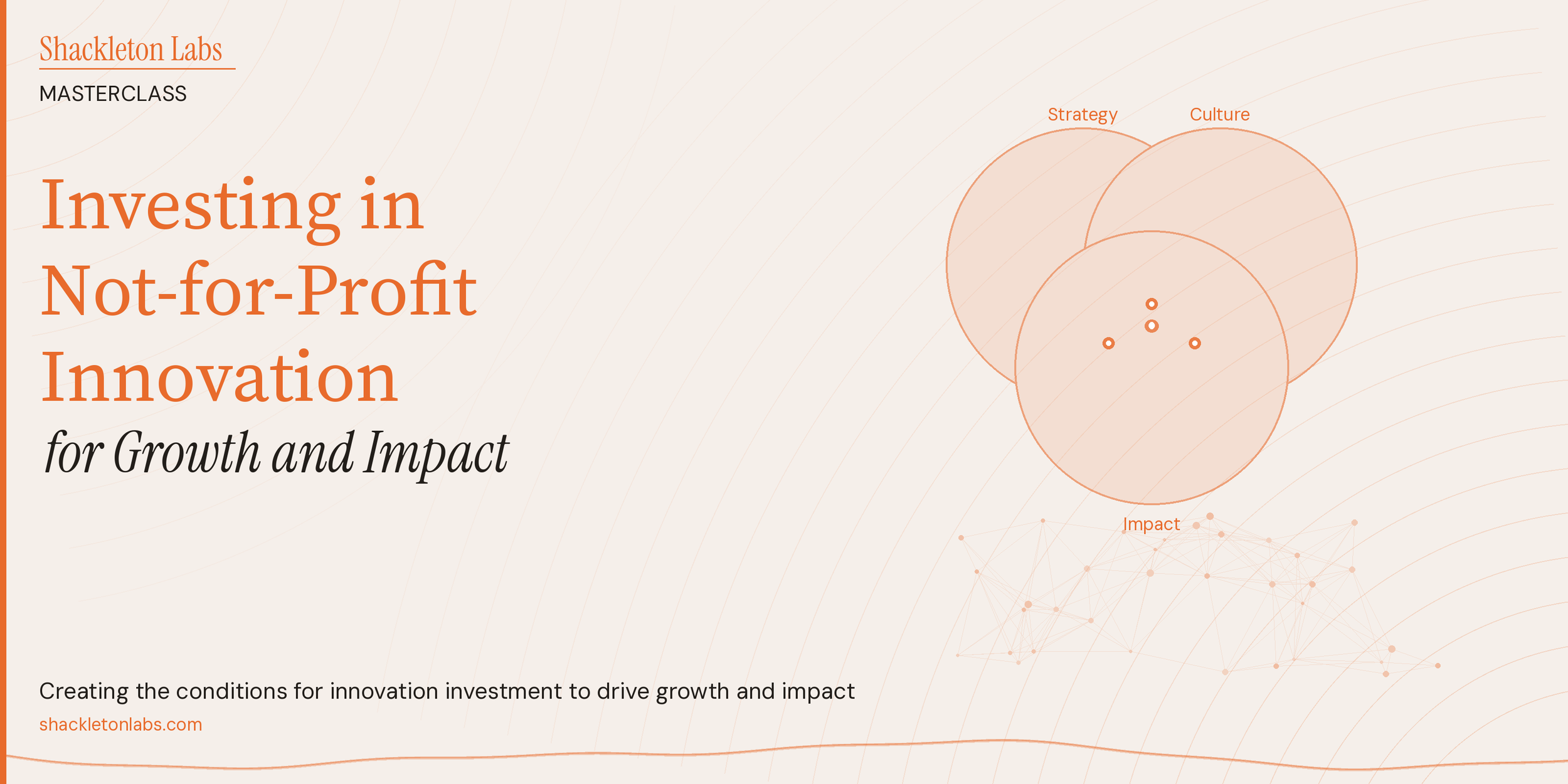
We know that psychological safety is absolutely vital for culture, but especially for not for profits that are seeking to be leading innovators. If this resonated with you, please come along our first Masterclass next Thursday. Early bird tickets close this Wednesday 18/3 at 5pm. Click here to book or on the image below.
Early Bird Tickets
